Total Pageviews

Showing posts with label Guy of Ponthieu. Show all posts

Thursday, 11 April 2013

The Story: Scene 3


Interpreting The Tapestry: Scene by Scene

Scene 3


Harold's ship leaves Bosham after he and his companions have feasted and rested. The here shows Harold and his men leaving his manor and wading into the sea to the prepared ship. Harold his carrying his dog and a hawk as does the fellow next to him. They are either gifts for the Duke of Normandy or he brings them because he is eager to hunt during the journey.

H
Next we see Harold's boat sailing out with around 14 men aboard. these were obviously Harold's handpicked men, his bodyguard, the well-trained huscarles. They are obvioulsy not expecting trouble for they bear no armour or arms. It appears that there may have been another boat load of men with him, for the boat in front is very different from the boat behind, although this is pretty consistent with theTapestry's habit of changing the style and colour of the same image. However there is also a boat that carries Harold and his men to the shore at Ponthieu that appears not to have a sail so he may have brought more than one boat with him.

According to the Norman sources, as we know, Edward has sent Harold on a journey to Normandy, to meet with Edward's second cousin, William, Duke of that land. Harold's mission was allegedly to confirm that the English crown would belong to the Duke upon the King of England's death.

Eventually they reach Ponthieu, the tapestry gives no indication that they have been blown of course, however if Normandy was there destination then perhaps they have. Sailing in the 11thc relied on engaging a sail with the wind and it was not uncommon for boats to get blown off course, though Harold was an experienced sailor having commanded Edward's Royal fleet in his youth. Interestingly, the borders of the Bayeux Tapestry are said to be a guide for the main piece but there doesn't seem to be any relevance in the imagery until we see the men with swords, indicating that as Harold and his men were alighting their ship, a fight ensued with Guy of Ponthieu's men on the shore.

William de Jumièges was a contempory chronicler and man of the Duke's. He stated that Harold landed in Ponthieu and was taken prisoner by Count Guy. The Bayeux Tapestry appears to reflect this and Harold is seen being manhandled as a man on a horse gives orders.

Ponthieu is a state to the north of Normandy. It was never part of the land that was handed over to the founders of the duchy and they are at this time, very proud of the fact that they successfully resisted any attempt to make them such. Their many songs and poems pay testimony to their wars with the Pagan invaders, then the religion of the ancestors of the Christian Normans. Guy of Ponthieu, or Wido, as he is referred to on the Bayeux Tapestry, had succeeded his brother Enguerrand in 1053 as count. Enguerrand had been married to Adelaide, William of Normandy's sister but around 1050, the marriage was anulled on the grounds of consanguinity. Another alliance had been forged between William of Talou, who was half uncle to William, and Enguerrand's sister. William of Talou challenged his nephew's right to the dukedom but the younger William had the backing of his great uncle Robert, powerful Archbishop of Rouen. As he was a brother-by-marriage to the Ponthieu brothers, they backed him in his rebellion. Of course this did not endear the brothers to William in the 1050s. It is interesting to note here as an aside, that the earliest surviving account of the Battle of Hastings was written by the brothers' uncle, Bishop Guy de Amiens. In 1053, William of Talou built the Castle of Arques and holed himself up there whilst William of Normandy sent an army to lay seige to it, allowing him and the rest of his army to be able to deal with other problems elsewhere on his borders, such as the French King. His loyal brother-in-law, Enguerrand was killed coming to the aid of Talou. Henry, the French king withdrew and William of Talou surrendered Arques and was sent into exile. This is when Guy took over as comites in Ponthieu.
In 1054, Henry decides to march into Normandy to bring his errant vassal to heel. His brother leads another army that contains Guy and his younger brother Waleran who is killed and Guy captured when they are ambushed.Guy spends two years imprisoned in Normandy whilst his uncle, the Bishop of Amiens sees to the running of his county. King Henry I of France was again defeated for the last time.
In 1056, Guy is released. William has been merciful, however, Guy is now his vassal and would have sworn an oath of allegiance to his new master. So why did Guy de Ponthieu take Harold prisoner when the Englishman, probably washed off course, lands on his beachhead;  especially when he knew what it was like to be held against his will.
According to a custom dating back to the 9thc, the counts of Ponthieu were able to ransom any persons, ships or property that landed upon their shore. The two men would have already met in 1056 at St Omer when they both bore witness on a charter for Eustace of Boulogne. Harold was a well travelled man who was thought to have been visiting Europe at that time on his way to meet with the nephew of King Edward, known as Edward the Exile, whom he may have been charged with bringing back to England. It is of course not known whether or not the men had discourse with one another. We can speculate that perhaps they did not like each other, or Guy did not like Harold, but most people spoke well of Harold. He was amiable, witty, intelligent, well read and could speak many languages. He may have been very charming to the women and no doubt many women would have admired these qualities. It might have had nothing to do with whether or not Guy disliked Harold; he was money as far as the greedy Count was concerned and whether or not he liked him was by the by. 

By 1064 (we cannot be sure of the exact date but most historians agree it was in this year) when Harold arrived on Ponthieu's shore, Guy might well have been an embittered man by this time. He had spent two years in a Norman dungeon, was humiliated and taught a harsh lesson by the Duke; his brothers had been killed in wars with Normandy and his own county reduced to a client-state of William's. Now here comes along a nice treasure for him, the wealthy Earl of Wessex. Many may have heard that Harold Godwinson was the power behind King Edward's throne. Next to the King he was the richest man in the land.And likely much richer than Guy de Ponthieu. Harold had land holdings all over England. His wife, Eadgyth Swanneck also had lands a plenty. Guy was well known for gaining funds through seizing shipments that came to his lands. Now here was the biggest prize of all.

References

Bates D (2004) William the Conqueror, The History Press.

Barlow F (2003) The Godwins: The Rise and Fall of a Noble Dynasty (The Medieval World), Longman.

Bridgeford A (2006) 1066: The Hidden History in the Bayeux Tapestry, Walker & Co.


Wednesday, 9 May 2012

A Tale of Two Boys

The tapestry shows the tale of Harold's journey to Normandy, his imprisonment by Guy de Ponthieu and his subsequent release into the hands of William of Normandy and his adventures there until he is coerced to take an oath to promise to be William's man and when the time comes, assist him to the throne of England. He is released back to England where he is shown accepting the crown himself after the death of Edward. What follows is the great preperation William undertakes to make a large fleet of boats to invade England with, the battle of Hastings and the demise of Harold and defeat of the English. There it stops abruptly but the final scenes are thought to have been damaged and probably concluded with the coronation of the victorious conqueror.


The Norman slant on this story is that Harold was comissioned by Edward to visit William with gifts and offerings to confirm his intention of naming him as heir. The English version was very different. Harold went on a mission to visit William with the sole purpose of negotiating the release of his brother Wulfnoth and nephew Hakon, against the advice of the King who told him that nought would come of it but trouble. This was Eadmer's version, a monk of Canterbury. It seems that Harold eventually returns to England with only one of the men he wanted to release, Hakon. Wulfnoth was to stay in Normandy presumably until William was crowned king. Hakon most likely died with his uncle the King at Hastings. 

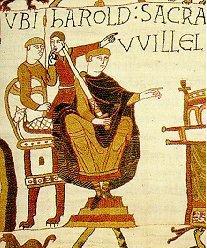
The two men do not appear in the tapestry by name but in a certain scene, where Harold stands before William, who is seated on his throne as his guest is gesticulating and pointing to the man who stands behind him sporting a beard and an English hairstyle. Because most of the men in the tapestry are either English or Franco/Norman, the distinction between the two races are often marked by such differences as cropped hair above the ears and clean shaven faces for the Normans and moustaches and full heads of hair for the English. Iconography exists quite often in the tapestry to signify a certain point that the artist is making. The chap that Harold appears to be pointing to is standing very much apart from the otherNorman knights behind him. He carries his shield under his arm and Bridgeford 2004 states that the shield is not dissimilar to the one that the Bayeux Tapestry shows Harold holding in the battle scenes. He goes on to make the claim that this is most likely Wulfnoth Godwinson, Harold's brother, the kinsman that it is said he came to plead for his freedom.

So, we have the dilemma. Which version do we believe? The Norman's justification for invading England was that Edward had sent Harold to Normandy with the explicit purpose of confirming William as the heir to his throne. Eadmer, who had access to people who might have known the full truth about Harold's journey, states otherwise and that Harold's sole reason for his journey to Normandy was to release his kinsmen. The images in the tapestry seem to follow Eadmer's version but without contradicting the Norman view. In the first scene, Harold is shown in a secret meeting with King Edward. If we are to follow Eadmer's version, we can interpret Edward listening to Harold explain his plans to visit William of Normandy to negotiate with him the release of his kinsmen. However, if we wanted to, we could also follow the Norman. Edward is discussing his request for Harold to visit his second cousin accross the sea to bestow his good wishes and confirm his heirship. Neither tale can be contradicted in the images.


So despite the different opinions that historians give, Harold returned with one of the men only. Hakon, who could have been around 16-17. He is believed to have died at Hastings, whatever the case nothing appears to be heard of him after that date. Wulfnoth has to stay until William is crowned and then he shall be released. However, as Harold defaults on his oath to smooth the way for William to take the throne, Wulfnoth is never released. He remains in captivity for the rest of his life freedom evading him for the second time when due his release upon the death of the Conqueror, William's successor William Rufus reneges on his father's promise to free him.


Wednesday, 11 April 2012

The Bayeux Tapestry: A Tale of Two Men


As we know, the tapestry is an embroidered work, created in the 11thc to convey the story of the events that led to the Norman Invasion of 1066. The main characters of this saga are Harold Godwinson and William, Duke of Normandy. It is a tale of two halves, the first half appears to be from Harold’s perspective and the second is more from William’s. Before their fateful meeting in 1064, there does not seem to be any recorded documentation that they ever met prior to this. William is only recorded in one English source as ever having been to England, as stated by Douglas (1953) and Harold was at this time, in Ireland in exile.

William, known as the Bastard and later known as the Conqueror, was born in Normandy around 1027, the baseborn result of his father, Duke Robert of Normandy's liaison with Herleva, the daughter of a tanner. Robert never married William's mother, although he may well have had some regard for her, for she also bore him a daughter, Adelaide. Because of her status, he would not have been permitted to marry her and eventually put her aside, finding a husband for her, one of his barons Herluin de Conteville. Herleva went on to give birth to two sons, Odo, Bishop of Bayeux and Robert the Count of Mortain and another daughter whose name is not recorded.

William was said to have been around 5ft 10 according to an examination of his femur bone, quite a tall man for his day. He was also said to have been strong, broad-shouldered and a strong bowman (Bates 2001). His voice was said to have been gruff and he seems to have had little in the way of culture. He was said to have not been able to read or write, in contrast to Harold who was a very well educated man. During his later years, he became very corpulent. Perhaps this was to compliment the avaricious reputation he had earned for himself.


                                                        Harold Godwinson


Harold Godwinson was born somewhere between 1022-24. He was the second son of Godwin, Earl of Wessex. His sister was Queen Edith, wife of the Confessor.The chronicler, Orderic Vitalis, says that he was very tall and handsome, possessed with great physical strength and charm, knowledge and courageous. The Vita Edwardi describes him as handsome, graceful and strong (Walker 1997). His strength and valour may be proven in the scene of the Bayeux Tapestry where he pulls to safety two drowning men. But Orderic finishes his flattering depiction of Harold by saying“But what were these gifts to him without honour, which is the root of all good? " Most likely in reference to Harold’s so-called perjury and oath-breaking.


He started his career as Earl of East Anglia. When his father got into trouble with the King over the Dover incident, Harold rallied to his father’s side with all his men. Unfortunately, the thegns and nobles were not willing to involve themselves at that time in a civil war and Godwin and his family was forced to flee into exile. Harold and his younger brother Leofwine went to Ireland to drum up support there, whilst the rest of his family fled across the sea to Flanders, to the protection of William of Normandy’s father-in-law, Count Baldwin. A year later, they were all back and restored to favour, convincing Edward to rid the country of those Norman’s in his retinue who had badly counseled him. Then when his father died, he was granted his Earldom of Wessex in 1053.

William was said to have coveted the English crown and it is quite likely that he visited England in 1051 when it was said that Edward had promised to make him his heir. The Norman's were to base William's claim on this fact when it was necessary to drum up support for William's venture to England to wrest the crown from Harold. William was to accuse Harold of perjury and breaking his oath as his 'vassal' to support his claim. In the autumn of 1064, Harold was to travel to Normandy. Strangely, the Anglo Saxon chronicle does not record this visit, but an English monk, Eadmer, writing in his Historia Novorum in Anglia, states that Harold wanted to gain the release of his brother and nephew, Wulfnoth and Hakon, who were hostages at William's court. Eadmer might have had access to the Godwin's through Harold's uncle Aelfric who was a cleric. It may have been from him that he got the information (Bridgeford).

Harold, Eadmer says, sailed for Normandy with a crew and was blown of course, ending up  on the shores of Ponthieu. The rogue count of Ponthieu, Guy, held him and his men captive and stole all the wealth that Harold had brought to secure his kinsmen's release. Fortunately, one of Harold's men escape and alerts the Duke who then sets about rescuing Harold, demanding his release from Guy. Guy is obviously intimidated by the Duke and Harold is handed over into William's care.

Imagine William's  delight to have the famous Harold Godwinson in his clutches? This was a chance for him to secure the support of the leading man of England. The fact that Harold had come for an entirely different purpose was by the by. Imagine Harold trying to explain that he was not there to confirm William with the heirdom without greviously incurring the dispeasure of his host who, on his home turf, would have had the upper hand. Harold might even try to explain that Edward had appointed Edgar as the atheling. Perhaps William would dismiss this stating that surely a young boy would not come before a man like he? No, Edward had promised him the crown and as far as he was concerned a promise was a promise. Harold would have heard of William's ruthless and brutal nature and most likely would have felt concerned for his and his men's safety.

Imagine Harold's horror when he realised he had made a dreadful mistake, one that was going to change the course of history forever.....